

Are you wondering how to measure your interpupillary distance, or pupillary distance, or PD, or... no, actually that's all for the names.
You are obviously in the right place because here at Horus-X, vision is our mission (a rhyme sponsored by the Dead Poets Society for good reasons; for any commercial inquiries, don't bother, they didn't leave an address).
Come on, follow the guide, we'll explain everything about this measurement which is so useful, among other things, for buying your glasses online.
Pupillary distance: what is it?
Behind this slightly technical term lies an important measurement, especially when you need to buy prescription glasses or sunglasses online.
In concrete terms, it is the distance between your two pupils. It is measured in millimeters and must be precise to avoid vision problems later on.

We can also talk about the half pupillary distance, which is the distance from the center of your nose to the center of your pupils. Logically, we add both values together to get the pupillary distance. This two-step measurement is actually more accurate.
👉 The pupillary distance (PD) is an important measurement because it allows your eyewear manufacturer to adjust the frame and lenses to your vision.
This way, your prescription or sunglasses lenses will be perfectly centered on your pupils, allowing for clear vision.
If the measurement is incorrect, the lenses of your glasses will not be centered on your eyes, causing dizziness, nausea, and headaches. Hence the importance of getting the right measurement.
Note that pupillary distance does not change, except during childhood. So if you are given a distance of 66 mm at age 30, it will still be 66 mm at age 60, provided you can live your life without encountering Francis Ngannou's fist.
How do you measure pupillary distance?
There are several methods, with varying degrees of reliability, for measuring pupillary distance (PD). We will describe them from the most reliable to the least reliable.
Measuring pupillary distance at the ophthalmologist's office
They are logically the best person to measure your interpupillary distance. An ophthalmologist is an eye doctor and has all the tools to accurately measure the distance between your two pupils. Stating the pupillary distance on the prescription has been mandatory in France since the 2014 Hamon Law. You can therefore find this value on an old prescription or wait 6 months for your next appointment 🙄.
An optician can do it
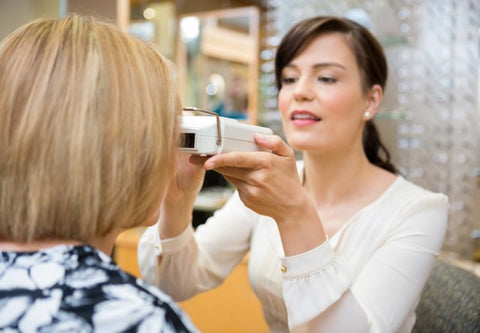
Opticians are also equipped with a pupillometer, which is the instrument used to measure pupillary distance. You just need to ask your optician for the value. You can also try to find a receipt for your prescription glasses or sunglasses, as the value is indicated there.
Using the Horus-X simulator
Did you know? For every pair of glasses sold on our shop, we offer a virtual try-on thanks to our online tool 😎. Here is how it works:
-
Go to your favorite pair of Horus-X glasses (our editor Aurélien, for example, swears so much by his Ushuaia round anti-blue light glasses that he bought the same ones as sunglasses; he's so imaginative)
-
Find the 3D Virtual Try-on button at the top left of the screen
-
After clicking the button, allow our application to use your webcam (otherwise we won't be able to measure the distance between your pupils!)
-
Look at the screen and try on your glasses (you look stylish, that's for sure!). Our tool acts as a smart mirror.
-
To get your interpupillary distance, look for the PD logo to the right of the simulator
-
After clicking on "PD", follow the instructions and the value will be given to you automatically.

Our tool is available for all our models, so you can choose the gaming glasses, casual anti-blue light glasses, or sunglasses that you prefer.
Measuring with a ruler
Here is the slightly less reliable "rough and ready" technique! You can ask someone to hold a ruler above your nose, at the level of your forehead. Place the "10 cm" mark in the center of your nose and ask your partner to note the distance between the "10 cm" mark and the center of your right pupil (same for the center of your left pupil). By adding the two values together, you will get an "approximate" pupillary distance (PD).

If you are alone, you can use a camera 📷 to capture your reflection in a mirror. You will then be able to measure the half-distance directly on the photo.
We find our online solution much more practical, but hey, to each their own method! Finding an old prescription for glasses is also a good way to get your distance value.
To sum up pupillary distance
Knowing your pupillary distance (PD) will allow you to buy prescription glasses, sunglasses, and more online or from your optician. It is a value that you can obtain in several different ways.
Since pupillary distance does not vary with age, we recommend that you keep the prescription your ophthalmologist gives you, as the value is legally indicated on it. If you cannot find your prescription, you can visit an optician to have them measure it for you.
And if you want to measure it without leaving your home, our online virtual try-on tool is made for you!